
Kickstarter Indie Game Marketing Tips for 2026
Most campaigns don’t fail because the game is bad. They fail because nobody told enough of the right people it exists — and the ones who found it weren’t convinced.
Key takeaways
Positioning is your first conversion tool. Before anyone backs your game, they need to understand it, and feel something about it (genre, style, art, characters) and you only have a few seconds to land that with a first impression.
Authenticity isn’t a vibe. It’s a strategy. Players back people they trust. Trust is built through consistent, honest content long before the campaign goes live.
Community is your most valuable launch asset. A Discord of 300 engaged followers will outperform a Twitter following of 3,000 passive ones on launch day every time.
Paid ads are not optional. Organic reach alone will not scale your backer count to where it needs to be. Paid advertising can scale quickly, and it’s what turns a funded campaign into an overfunded one.
In 2026, the noise on Kickstarter is louder than ever. More games are launching, more developers are learning the basics, and the bar for what a campaign needs to look like before backers trust it has quietly risen. The tactics that worked years ago (a halfway decent trailer, some social posts, press coverage and hoping Kickstarter’s algorithm finds you) are not the tactics that you can rely on alone and that fund campaigns today.
What does work is a combination of four things that compound on each other: a clear and compelling positioning, a genuine foundation of trust and authenticity, a community built before you need it, and paid advertising that amplifies all three. Get all four working together, and you are not just hoping to fund, you are building the conditions where funding becomes almost inevitable, and you have an eager community to bring with you along the way, for the long run.
This one's a big one, so bear with me here – I’ve tried to make this as simple as possible, but take your time to really get into the depths of it all. Here is how each one works, and how to actually execute it.
1. Product Positioning: Make Your Game Unmistakable
Positioning – what the hell is that – this is one of those marketing concepts that sounds abstract until you realise it is the first thing a potential backer does, or doesn’t understand when they land on your page. In brand marketing, positioning is typically broken into four layers: salience, performance and imagery, judgement and feelings, and resonance. For video games on Kickstarter, each layer does a specific job.
Salience: The One-Second Test
Salience is whether your game registers at all, whether it lands in the mind quickly and clearly. Most Kickstarter pages fail this test. The hero image is vague, the subtitle is wordy, and the visitor has no idea what kind of game this is or why they should care.
For an indie game, salience lives in three places:
Your capsule art
Your headline
The first five seconds of your trailer
These are not the places for nuance. They are where your game makes a single, clear first impression. Keep it simple. Make it scannable. Genre, tone, and premise in one glance.
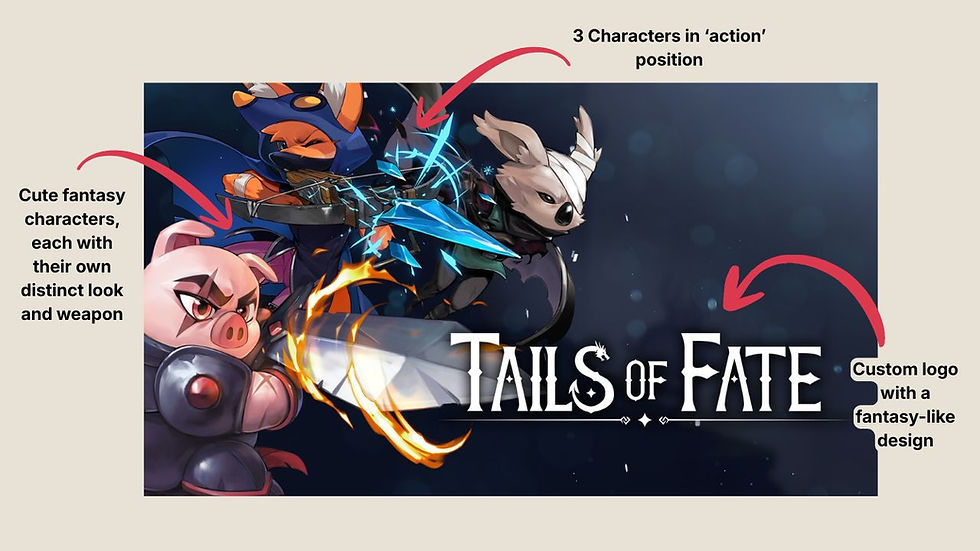
Real example: Tails of Fate's visual identity communicated its genre and tone immediately. Three distinct characters in a ready-to-fight stance, hand-drawn art that stood out in a feed of 3D renders and pixel art. A visitor didn't need to read a paragraph to know what they were looking at. That immediate recognition contributed directly to the campaign raising over $110,000 from 1,673 backers in 32 days.
Performance and Imagery: What Does Your Game Actually Do?
This is your genre, your core loop, your unique mechanic - what you do that no other game in your space does. Imagery goes deeper. It is the atmosphere, the feeling, the world a player enters when they see your game running.
"A turn-based RPG with over 40 hours of content" - performance data, not imagery
"A narrative RPG where every decision reshapes the world and the characters you travel with remember everything" - that is a picture
Backers are not funding a feature list. They are funding a feeling they want to experience. Describe the feeling.
Applied to Tails of Fate: The campaign didn’t just describe its mechanics; it communicated what playing the game would feel like. The character-driven storytelling and the emotional weight of choice were front and centre. Backers weren’t funding a feature list. They were funding a feeling they wanted to experience.

Judgement and Feelings: Do I Trust This Team?
Judgement is the rational check: will this actually get finished? Is the team capable? Are the rewards realistic? Feelings are the emotional response: do I want this to exist?
A campaign page with a faceless logo and no team section feels anonymous
A campaign backed by months of devlogs, active replies, and a visible human behind the project triggers a completely different response
Build that trust before you announce a Kickstarter. Your community should arrive at launch already wanting to support you
Players back people before they back products. The question isn't just 'do I want this game?'. It's 'do I believe the person making it will actually deliver?'
Players back people before they back products. The question isn’t just “do I want this game?” — it’s “do I believe the person making it will actually deliver?”
Resonance: This Was Made for Me
Resonance is when a potential backer reads your page and thinks: this is exactly the game I have been waiting for. Not 'looks interesting', but 'this is mine.'
Go narrow, not broad. Specificity creates resonance, broad appeals create nothing
Reference your specific inspirations. Players who love those games will feel immediately seen
Speak directly to the player who will love this game, not every gamer on the planet
Tails of Fate built resonance by knowing exactly who their game was for and speaking directly to that person. The result: a 20% follower-to-backer conversion rate. That is resonance doing its job.
2. Trust and Authenticity: The New Performance Marketing
Players who back indie games in 2026 have become significantly better at detecting when trust is absent. They have seen campaigns that over-promised. They have backed games that did not deliver. The bar for credibility has moved.
There are two components to building trust as an indie game on Kickstarter: what you say and do yourself, and who else is saying it for you.
What You Build Before You Ask for Anything
Trust is not something you create during a campaign. It is something you arrive at a campaign with.
Share your process, not just your highlights
Be visible as a person, not just as a brand
When something goes wrong or gets delayed, say so publicly and tell your community what you are doing about it
Reply to comments, respond in Discord, make individuals feel seen - 1:1 communication compounds
Transparency sounds risky. In practice, it is one of your strongest conversion tools. The developers who fund in under 24 hours built that outcome in the months of honest content that came before it.
Leveraging Content Creators and Timing It Right
Creator coverage is underused in Kickstarter marketing and frequently mishandled when it is used.
Find the right creators, not the biggest ones:
A YouTube channel with 8,000 subscribers focused on narrative RPGs is worth more to the right campaign than a 500,000-subscriber general gaming channel
Look for genre streamers, Let's Play creators, indie-focused TikTok and YouTube channels
Audience overlap with your target player matters more than follower count
Engage before you pitch:
Follow their content, comment genuinely, share their posts
Become a recognisable name in their community before you ever send a message
A pitch from someone who clearly watches their content lands completely differently to a cold email
Make it easy when you do reach out:
Offer an early access key, a demo build, or early campaign access
Send a short press kit. Key art, a one-paragraph pitch, clear contact details
Give them everything they need to make a decision in under two minutes
Time coverage for your live campaign:
Creator coverage during pre-launch has nowhere to convert - your page is not live yet and you don't have anything to offer.
Target the first seven to ten days of your live campaign
That ticking clock adds real conversion pressure that did not exist before launch
A creator with a small, passionate audience covering your game in week one of your live campaign is worth ten times the same creator covering it before launch. Timing is not a detail - it is the difference between coverage that converts and coverage that just looks good in your analytics.
3. Community Building: Your Most Scalable Launch Asset
A social media following and a community are not the same thing. A following is passive. A community is active. One gives you numbers. The other gives you backers.
The gap between social activity and committed Kickstarter pre-saves is exactly where most campaigns lose momentum. The work is moving people from passive observers to active participants with a genuine reason to follow the campaign specifically.
When Tails of Fate came to Full Charge, they had good engagement on X, but their Kickstarter followers weren’t growing proportionally. That gap between social activity and committed pre-saves is exactly where most campaigns lose momentum. In four weeks, the campaign grew to over 1,200 Kickstarter followers. The distinction was moving followers from passive observers to active participants with a reason to follow the campaign specifically, not just the social accounts.
Build the Infrastructure Before the Audience
Before you grow your community, you need somewhere for it to live. Discord is the right platform, not because it is trendy, but because it enables the 1:1 communication that turns followers into advocates.
Keep it simple. General chat, devlog updates, feedback, and a space for your most dedicated members
Run playtest sessions and share exclusive updates there first
Make early supporters feel genuinely invested in the development, not just subscribed to something
An empty Discord is worse than no Discord. Open it when you are ready to be active in it.
Nurture the Path from Follower to Backer
The content that moves people along this path is not polished announcements. It is:
Behind-the-scenes content that makes followers feel involved
Genuine questions that invite real responses, 'We're choosing between two magic system designs, which would you actually want to play?'
Public acknowledgement of community members who have been engaged for months
Updates that treat followers like co-creators, not an audience
When that feeling is strong enough, a Kickstarter launch does not feel like a sales pitch. It feels like a shared milestone, and that shift changes everything about how your community responds.
Use Community as a Feedback Loop
Beyond engagement, your community is one of your most valuable development assets.
Playtest sessions surface things no internal review will catch
Act on feedback visibly - 'You told us combat felt slow, here is what we changed'
Every visible act of listening creates social proof that every new visitor to your Kickstarter page can see
This is not just good community management. It is free market research from your target audience, and it compounds into social proof that every new visitor to your Kickstarter page can see.
4. Paid Advertising: The Multiplier You Can’t Afford to Skip
Positioning, trust, and community set the table. Paid advertising fills the seats. In 2026, with organic reach on most platforms at historic lows, running a Kickstarter without any paid advertising is the equivalent of opening a shop with a great sign above the door and then not telling anyone the address.
You do not need a huge budget. You need a smart one.
Meta (Facebook and Instagram) Remains the Primary Channel
For indie game Kickstarters, Meta (Facebook and Instagram) remains the highest-performing paid channel. The targeting depth is unmatched at an indie-accessible budget.
Target by genre interests, comparable game titles, Kickstarter backer behaviour, and custom audiences from your email list
Pre-launch goal: build Kickstarter followers and email subscribers — not pledges yet
Live campaign goal: retarget your warm audience and convert them
Tails of Fate achieved a 2.6x ROAS (Which is pretty bang on industry average benchmarks) during the live campaign and 1.4 million impressions across the full run. That performance was built on pre-launch ad spend that had already warmed the audience before a single pledge was possible.

Structure Your Campaign in Two Phases
Pre-launch (six to eight weeks out):
Run awareness and lead generation ads to cold audiences
Layer interests: genre, comparable titles, Kickstarter platform itself
Test three to five video creatives and ten to fifteen static images
Watch cost-per-lead, under £2 per Kickstarter follower, scale up; higher, pause and test new angles
Live campaign (days one to thirty):
Shift entirely to warm retargeting. Page visitors, ad engagers, email list
These people have already expressed interest. Your job is the final push to pledge
You are not building an audience during the live campaign. You are converting one you already built

Creative Is the Most Important Variable
In paid advertising for games, your creative matters more than your targeting, budget, and bidding strategy combined.
A compelling 6-15-second gameplay clip showing your game's most satisfying moment will outperform a polished but generic image every time
Test early. The pre-launch phase is your creative laboratory
The data you collect in pre-launch tells you what your audience responds to before you spend live campaign budget on it
For Tails of Fate retargeting, 18 different ad variations were tested: images, characters, and video assets, all with different call to actions announcing phases of the campaign (launch, fully funded, stretch goal unlocks)— resulting in an average ROAS of 5.7x.

Beyond Meta: Reddit and Kickstarter Ads
Reddit ads place your campaign in front of subreddits aligned to your genre — r/JRPG, r/patientgamers, r/indiegaming, r/Kickstarter
Contextual relevance from a well-matched subreddit produces exceptional traffic quality
Kickstarter's own ad platform targets logged-in users actively browsing for campaigns to back — as warm an audience as you will find
You can also take advantage of Reddit's free $500 ad credit after you spend $500.
The developers who fund in under 48 hours are no luckier than everyone else. They entered launch day with a warm audience, a positioned campaign, and paid ads ready to scale the moment the page went live. That is a system, not a stroke of fortune.
Putting It All Together
These four pillars are not independent strategies. They are a system.
Positioning makes your paid ads convert - without it, your cost per backer spikes
Trust makes your community grow with intent - without it, engagement stalls
Community makes your launch day convert at rates no cold audience can match
Paid advertising amplifies everything you have already built
Strip out any one pillar and the others weaken. The campaigns that hit their funding goal in under 24 hours and keep climbing to 200%, 300%, and beyond are the ones where all four are working simultaneously.
The developers who fund in under 48 hours are no luckier than everyone else. They entered launch day with a warm audience, a positioned campaign, and paid ads ready to scale the moment the page went live. That is a system, not a stroke of fortune.
Start building earlier than you think you need to. Your Kickstarter launch should be the result of months of compound effort - not a starting line from zero.
If you want the full playbook, including page design templates, email sequences, and budget-free tactics, the Free Kickstarter Marketing Guide from Full Charge covers everything you need to build your launch from the ground up: fullcharge.games/free-kickstarter-guide
Launching your game on Kickstarter?
Full Charge helps indie developers build the audience, strategy, and ads needed to launch funded campaigns. Get in touch at fullcharge.games — the earlier you start, the better your launch.


